DRAG
 DRAG


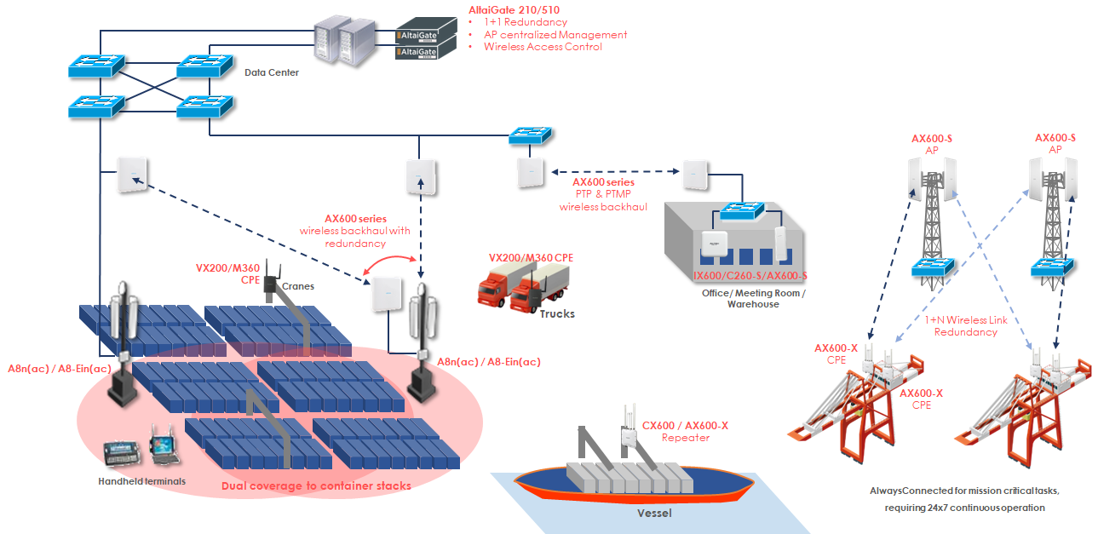
Industry 4.0 involves interconnected cyber-physical systems where a network of intelligent devices, such as handheld terminals, cranes, trucks, and cameras, exchange data to enhance operations. Reliable communication technology is crucial, especially in container ports, which serve as critical hubs for global trade and require high-capacity connectivity to manage their operations effectively. Altai Super WiFi™ solutions provide extensive coverage across large port areas, ensuring seamless communication between cargo handling equipment, logistics systems, and personnel. Our solution facilitates real-time tracking of container movements, enhances safety protocols, and improves operational efficiency. By fostering connectivity and streamlining operations, Altai Super WiFi™ reduces costs and improves outcomes, enabling ports to handle increasing volumes of cargo while minimizing delays.
Wi-Fi facilitates wireless communication between handheld devices (tablets, interphone, laptops) and Container Management Systems ( CMS ), enhancing operational efficiency in:
Wi-Fi connects Vehicles to the CMS for:
Wi-Fi supports Wi-Fi camera, allowing surveillance data transmission to central system. This capability enables:
Wi-Fi facilitates connection between automated RTG and remote operation center (ROC) via the wireless network for:

Usually there are several quay cranes at each berth moving along a rail parallel to the container vessel, This leads to blockage of Wi-Fi signal to on-board or quay-side container checker just behind the crane, resulting in blockage of transmission.

Interferences come from the AP of office buildings nearby and the other container ports at a distance, leads to poor signal reception and low transmission data throughput, causing a lot of delay

Usually, container ports are located in low and wide-spread areas with limited high points for installation. Typical available points for Wi-Fi antenna installation are at the top of light tower, lamppost or rooftop of building.
Limited by the roaming capability, some legacy Wi-Fi client devices stick to the weak signal to cause low transmission data throughput and a lot of delay. Packet loss is not allowed for mission-critical applications during roaming.

The failure of Wi-Fi service (accessing the server) may be due to the failure of wireless access (radio failure), wired backhaul (Ethernet or fiber failure) or application server (server congestion)
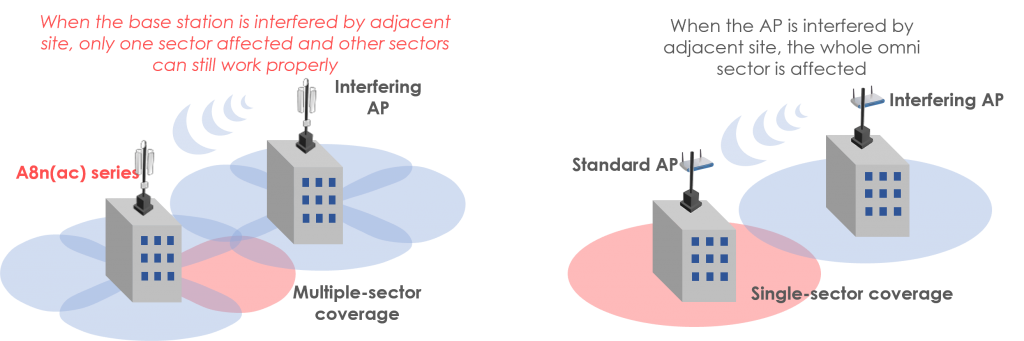
Altai patented smart antenna technology increases Wi-Fi coverage while minimizing the number of access points needed, resulting in reduced capital and operational expenditures.
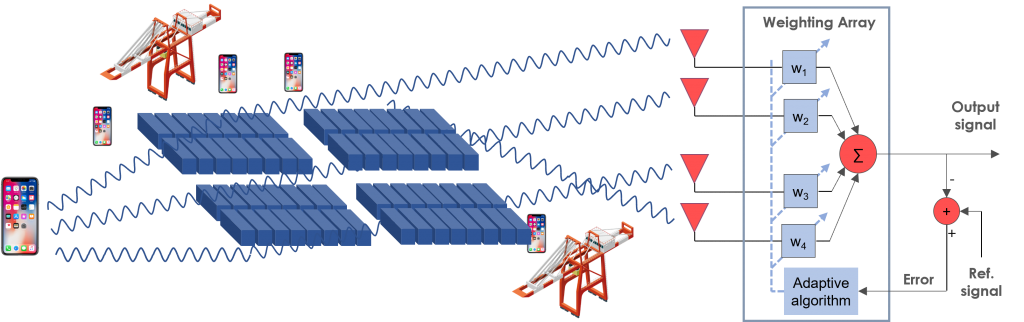
The smart antenna technologies enable more robust performance in highly interfered areas. In case of interference in one sector, the other sectors of the multiple antennas system can still work properly.
By utilizing the built-in automatic channel selection feature, the system will automatically select the channel with the least interference. This automatic channel selection can be scheduled at a predefined time, ensuring that the system is consistently refreshed to the best available channel.
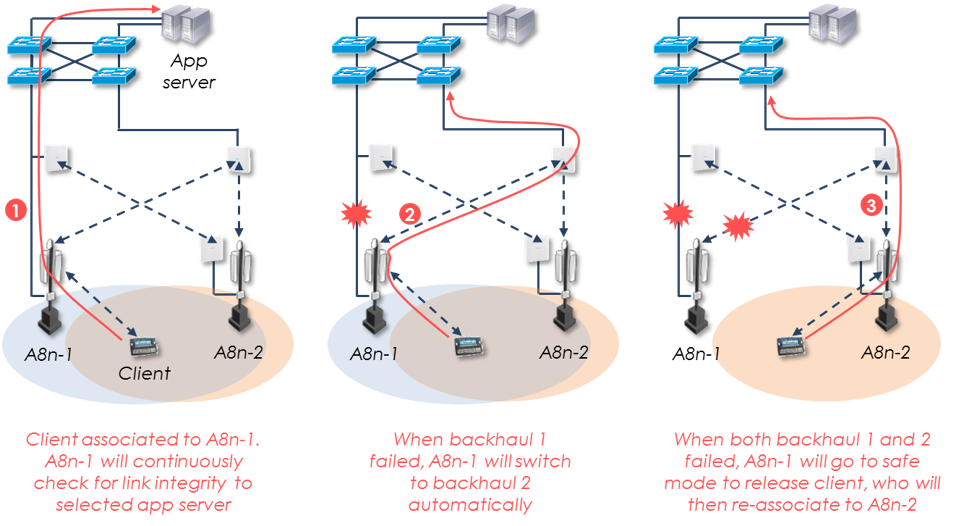
The link integrity function will check the complete link integrity status by pinging to several pre-defined App server IP addresses at pre-defined time intervals. In case a link failure, the Altai AP will switch from the default backhaul 1 to the standby backhaul link.
When both backhaul link failed, the radio will go to Safe Mode and the user SSID will be automatically turned down. In this way, the users will be forced to associate to another healthy Altai AP.
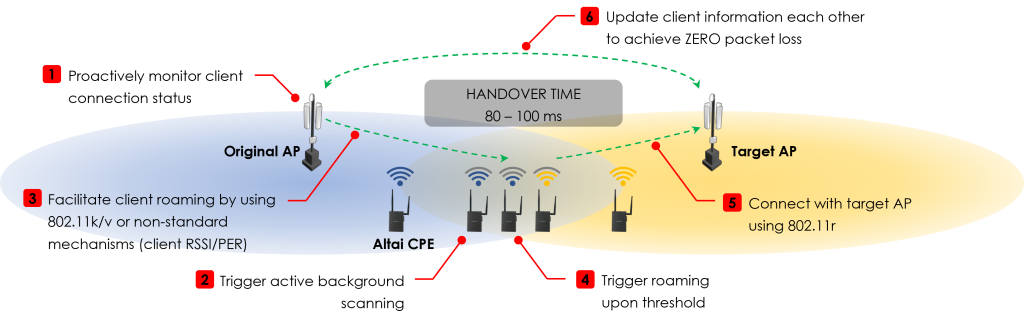
Fast Handover – Enhanced active background scanning and roaming threshold enable Altai CPE to have a handover time of 80~100 ms
Smart Roaming – Altai AP proactively monitors client connection status and uses standard (802.11k/v/r) or non-standard mechanisms (client RSSI/PER) for facilitating client roaming to mitigate the effects of poor handover decisions made by clients alone
Zero Packet Loss – The Altai APs involved in roaming communicates with each other to enable intelligent packet buffering and forwarding, reducing packet loss to zero
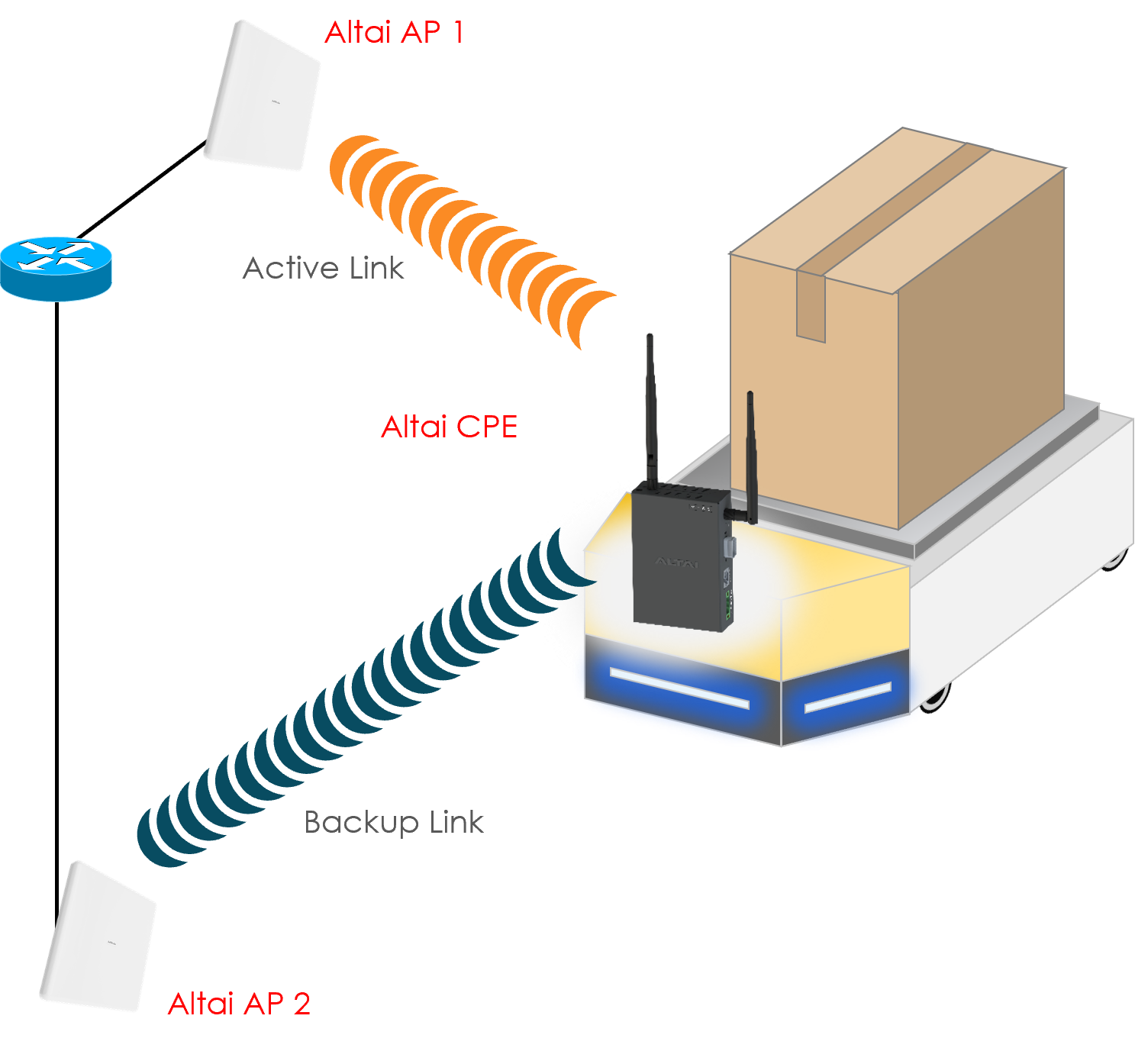
To accommodate the needs of delay-sensitive and mission-critical applications, Altai offers AlwaysConnected solutions. It is a setup consisting of multiple wireless links, one in active and the rest in standby, to provide robust and loop-free connectivity. Since the links are already in place, the system can simply do the link switching in no time when the active links becomes poor.
With Altai proprietary protocol used in AlwaysConnected solutions, the link switching time can be achieved down to 10 ms.
Waveguide is a special type of transmission line in the form of a hollow metal tube, with electromagnetic waves transmitted inside by successive reflections from the inner walls of the tube. When perforated with slots in certain pattern, a waveguide can become a leaky wave antenna. When RF signal is fed into the waveguide, it will leak through the slots along the waveguide.
An AP that connects to the backend network (i.e. the remote operation center) is installed at one end of the waveguide and feeds Wi-Fi signal in. On the other hand, a Wi-Fi CPE is installed on the RTG with antenna pointing to the waveguide, thus setting up an AP-CPE wireless link for the communication between RTG’s local network and the remote operation center.